Betrayal Trauma Awareness Day
May 25
Because Betrayed Partners Deserve to Be Seen, Understood, and Properly
Supported.
Because Betrayed Partners Deserve to Be Seen, Understood, and Properly Supported.
#BetrayalTraumaAwarenessDay
The first-ever Betrayal Trauma Awareness Day was created to bring awareness to one of the most overlooked mental health conversations surrounding infidelity: betrayal trauma.
For far too long, betrayed partners have silently struggled with panic, intrusive thoughts, hypervigilance, emotional flooding, sleeplessness, nervous system dysregulation, and PTSD-like symptoms after betrayal while being told to simply “move on,” “forgive,” or “work on the marriage.”
Meanwhile, many have been made to feel weak, dramatic, bitter, or emotionally unstable for struggling so deeply after infidelity.
Betrayal Trauma Awareness Day was created to help change that conversation.
This awareness day exists for every betrayed partner who has ever questioned their sanity after betrayal, felt misunderstood in counseling, been pressured to forgive before feeling emotionally safe, or silently believed something was wrong with them because they could not simply “forgive and forget.”
The goal of Betrayal Trauma Awareness Day is not to shame relationships or discourage healing between couples. The goal is to finally bring recognition to the profound mental health and nervous system impact infidelity can have on the betrayed partner.
MAY 25
Awareness Day
The first-ever Betrayal Trauma Awareness Day was created to bring awareness to one of the most overlooked mental health conversations surrounding infidelity: betrayal trauma.
For far too long, betrayed partners have silently struggled with panic, intrusive thoughts, hypervigilance, emotional flooding, sleeplessness, nervous system dysregulation, and PTSD-like symptoms after betrayal while being told to simply “move on,” “forgive,” or “work on the marriage.”
Meanwhile, many have been made to feel weak, dramatic, bitter, or emotionally unstable for struggling so deeply after infidelity.
Betrayal Trauma Awareness Day was created to help change that conversation.
This awareness day exists for every betrayed partner who has ever questioned their sanity after betrayal, felt misunderstood in counseling, been pressured to forgive before feeling emotionally safe, or silently believed something was wrong with them because they could not simply “forgive and forget.”
The goal of Betrayal Trauma Awareness Day is not to shame relationships or discourage healing between couples. The goal is to finally bring recognition to the profound mental health and nervous system impact infidelity can have on the betrayed partner.
MAY 25
Awareness Day
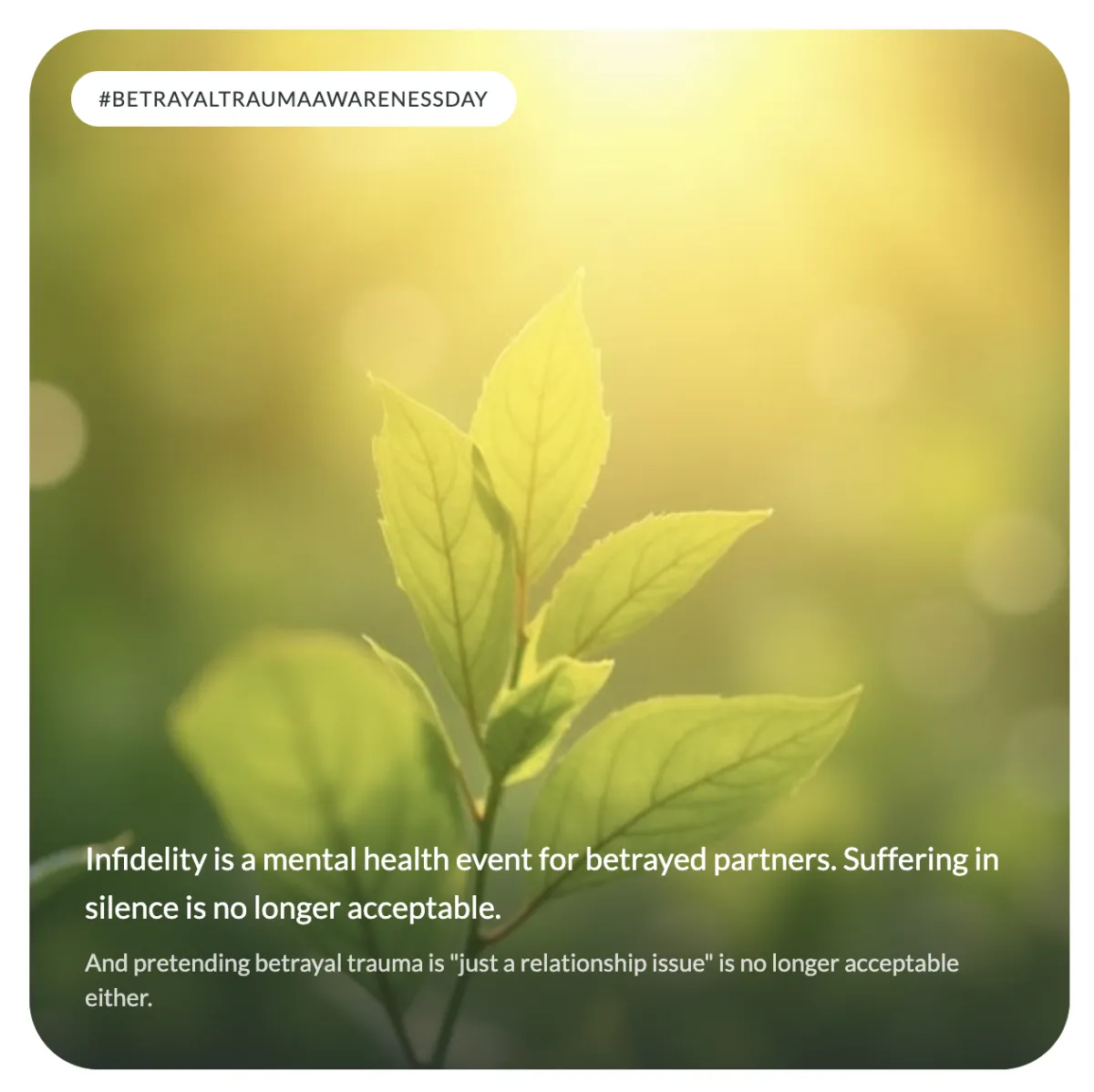
Infidelity is a mental health event for betrayed partners.
What Is Betrayal
Trauma?
Betrayal trauma is the emotional, psychological, and nervous system injury that can happen when someone you deeply trusted shatters your sense of safety, attachment, trust, and reality through infidelity or profound betrayal.
For many betrayed partners, discovering infidelity does not feel like ordinary heartbreak. It feels like psychological collapse.
Many betrayed partners experience panic, anxiety, hypervigilance, intrusive thoughts, emotional flooding, obsessive replaying of details, nervous system dysregulation, difficulty concentrating, loss of self-trust, and PTSD-like symptoms after infidelity.
If this sounds familiar, you are not weak. You are not overreacting. And you are not “crazy”.
Your mind and body are responding to profound betrayal trauma.
Why Betrayal Trauma Is So Often Misunderstood
One of the most painful parts of betrayal trauma is how often betrayed partners are made to feel like their
trauma responses are the problem.
In many traditional counseling environments, the focus after infidelity immediately becomes saving the marriage, rebuilding trust, improving communication, reconciliation, and “shared responsibility.” Meanwhile, the betrayed partner may still be emotionally flooded, unable to sleep, trapped in survival mode, and struggling with severe nervous system dysregulation after betrayal.
Many betrayed partners are encouraged to forgive or reconnect before their trauma has even been acknowledged. Some are subtly made to feel weak, dramatic, bitter, or unwilling to “move on” because they
cannot simply “forgive and forget.”
But betrayal trauma is not weakness. And trauma responses are not relationship failures.
For many people, infidelity becomes a profound mental health event.
#BetrayalTraumaAwarenessDay
Why Betrayal Trauma Is So Often Misunderstood
One of the most painful parts of betrayal trauma is how often betrayed partners are made to feel like their trauma responses are the problem.
#BetrayalTraumaAwarenessDay
In many traditional counseling environments, the focus after infidelity immediately becomes saving the marriage, rebuilding trust, improving communication, reconciliation, and “shared responsibility.” Meanwhile, the betrayed partner may still be emotionally flooded, unable to sleep, trapped in survival mode, and struggling with severe nervous system dysregulation after betrayal.
Many betrayed partners are encouraged to forgive or reconnect before their trauma has even been acknowledged. Some are subtly made to feel weak, dramatic, bitter, or unwilling to “move on” because they
cannot simply “forgive and forget.”
But betrayal trauma is not weakness. And trauma responses are not relationship failures.
For many people, infidelity becomes a profound mental health event.
"Betrayed partners are not just struggling with relationship problems. They are misunderstood trauma survivors."
— Beth Fischer, M.Ed.

Beth Fischer, M.Ed.
Founder of Healing Families LLC
Creator of The Betrayal Trauma Healing Method®
A Message from Beth Fischer
“Betrayal trauma after infidelity isn’t just heartbreak and emotional pain. It’s a nervous system injury.
Many betrayed partners are experiencing panic, hypervigilance, intrusive thoughts, emotional flooding, and PTSD-like symptoms after betrayal, yet they are often told to forgive, move on, or fix the marriage before
their trauma has even been acknowledged.
I created Betrayal Trauma Awareness Day because betrayed partners deserve to feel seen, validated, understood, and properly supported with trauma-informed care after infidelity. My mission is to help shift the conversation around infidelity recovery away from simply ‘saving the relationship’ and toward healing the individual by recognizing the very real mental health impact betrayal trauma has on betrayed partners.
No more suffering in silence. No more minimizing the pain of betrayal trauma. And no more treating betrayal trauma like it’s ‘just a relationship problem’ when it’s a mental health event for the betrayed partner.”
A Message from Beth Fischer
Beth Fischer, M.Ed.
Founder of Healing Families LLC
Creator of The Betrayal Trauma Healing Method®
“Betrayal trauma after infidelity isn’t just heartbreak and emotional pain. It’s a nervous system injury.
Many betrayed partners are experiencing panic, hypervigilance, intrusive thoughts, emotional flooding, and PTSD-like symptoms after betrayal, yet they are often told to forgive, move on, or fix the marriage before
their trauma has even been acknowledged.
I created Betrayal Trauma Awareness Day because betrayed partners deserve to feel seen, validated, understood, and properly supported with trauma-informed care after infidelity. My mission is to help shift the conversation around infidelity recovery away from simply ‘saving the relationship’ and toward healing the individual by recognizing the very real mental health impact betrayal trauma has on betrayed partners.
No more suffering in silence. No more minimizing the pain of betrayal trauma. And no more treating betrayal trauma like it’s ‘just a relationship problem’ when it’s a mental health event for the betrayed partner.”
You Are Not Alone
For years, many betrayed partners have silently wondered:
“Why can’t I move on?”
“Why am I struggling this deeply?”
“Why does this feel traumatic?”
“Why does nobody seem to understand?”
Betrayal Trauma Awareness Day exists to help betrayed partners understand there is nothing “crazy” about trauma responses after profound betrayal. Millions of betrayed partners are navigating the psychological and nervous system impact of infidelity right now. And no one should have to suffer through it alone.
No one should have to suffer through it alone.
Frequently Asked Questions
Is betrayal trauma real?
Yes. Betrayal trauma is a real psychological and nervous system response that can occur after infidelity, deception, emotional betrayal, or repeated violations of trust within an intimate relationship.
Can infidelity cause PTSD-like symptoms?
Yes. Many betrayed partners experience symptoms that closely mirror PTSD after infidelity, including panic, hypervigilance, intrusive thoughts, anxiety, sleeplessness, emotional flooding, and nervous system dysregulation.
How can I support Betrayal Trauma Awareness Day?
You can support Betrayal Trauma Awareness Day by helping raise awareness around the mental health impact of infidelity and betrayal trauma. Supporters are encouraged to share educational resources, talk openly about betrayal trauma, repost awareness content, support betrayed partners with compassion, and help normalize trauma-informed conversations around infidelity recovery.
On May 25, supporters can also participate by using the hashtag: #BetrayalTraumaAwarenessDay
Every conversation helps betrayed partners feel less alone, less misunderstood, and more validated in what they are experiencing.
Why does betrayal trauma feel so overwhelming?
Betrayal trauma can feel overwhelming because betrayal disrupts emotional safety, attachment, trust, identity, and predictability. The nervous system may interpret this rupture as danger, causing survival responses to activate.
Why do many betrayed partners feel “crazy” after infidelity?
Many betrayed partners feel emotionally destabilized because betrayal trauma is still widely misunderstood and minimized. People are often told to “move on” or “forgive” without understanding the profound trauma responses betrayal can create.
Why do many betrayed partners feel misunderstood in counseling?
Many traditional counseling approaches focus heavily on saving the relationship or rebuilding trust before the betrayed partner’s trauma has been fully acknowledged. This can leave betrayed partners feeling emotionally dismissed or pressured into reconciliation before they feel emotionally safe.
What is trauma-informed infidelity recovery?
Trauma-informed infidelity recovery recognizes the profound mental health and nervous system impact betrayal can have on the betrayed partner. It prioritizes emotional safety, nervous system stabilization, validation, and healing before focusing on relationship repair.
Why was Betrayal Trauma Awareness Day created?
Betrayal Trauma Awareness Day was created to raise awareness around the overlooked mental health impact of infidelity and help betrayed partners feel seen, validated, understood, and properly supported.
What helps betrayal trauma heal?
Trauma-informed support, nervous system regulation, emotional stabilization, boundaries, education, self- trust rebuilding, and compassionate support can all help healing begin.
#BetrayalTraumaAwarenessDay
Email: [email protected]
Copyright 2026. Healing Families LLC. All rights reserved.
Disclaimer: The information provided in all 1:1 sessions, online videos, masterclasses, and coaching programs are for educational and informational purposes only. Results mentioned or implied are not typical and may vary based on individual effort, commitment, and circumstances. True transformation and positive life changes can only be achieved through dedicated implementation of the strategies and techniques provided in any session and/or program. The success of your experience when working with Beth Fischer and all affiliates of Healing Families LLC is ultimately dependent on your willingness to actively participate and apply the guidance provided. Healing Families LLC and its representatives and affiliates are not responsible for any outcomes or consequences resulting from your participation in any sessions or programs.